Noncompetes Across the Line: How Maryland and D.C. Treat Workers Very Differently
Table of Contents
A practical, worker-side guide to noncompetes in Maryland and the District of Columbia.
If you live in the D.C. or Maryland area and your employer has just put a noncompete in front of you, the single most important question is not what does it say? — it is which side of the Beltway are you on? Maryland and the District of Columbia have moved to restrict noncompete agreements over the last five years, but they have done so in very different ways, with very different thresholds, and with very different consequences for the worker who reads the fine print too late.
You may remember the headlines: in April 2024, the Federal Trade Commission issued a sweeping rule banning most noncompetes nationwide. That rule never took effect. The FTC, itself voted to vacate the rule. In February 2026, the FTC formally removed the noncompete rule from its books.
What this means for you: there is no federal noncompete ban. The FTC is not your safety net. Whether your noncompete is enforceable depends almost entirely on the law of your State or the District of Columbia.
02 — Maryland
A patchwork that punches hardest at low wages and direct patient care.
Maryland regulates noncompetes through a statute (Md. Code, Lab. & Empl. § 3-716) layered on top of decades of common-law decisions. There are four buckets to know.
The Low-Wage Worker Ban
Maryland voids any noncompete imposed on an employee earning at or below 150% of the State minimum wage. As Maryland’s minimum wage climbs, so does this ceiling. Because the statute keys off 150% of the State minimum wage, a higher county or local minimum wage (such as Montgomery County’s) does not raise this ceiling.
The Healthcare-Specific Ban (the big 2025 change)
This is the most consequential recent change in Maryland law, and the one most physicians, PAs, nurses, nurse practitioners, dentists, and other clinicians need to understand. House Bill 1388, signed in April 2024, took effect for agreements executed on or after July 1, 2025. It applies to anyone:
required to be licensed under the Maryland Health Occupations Article, and
employed in a position that provides direct patient care.
If you earn $350,000 or less in total annual compensation, a noncompete or “conflict of interest” provision in your contract is void. If you earn more than $350,000, your employer can still impose one — but the statute puts a hard ceiling on it: a maximum of 1 year from your last day of employment, and a geographic radius of no more than 10 miles from your primary place of employment. The employer must also notify patients when a healthcare professional affected by these restrictions moves to a new practice location. One critical point of timing: this healthcare ban is not retroactive. It applies only to agreements executed on or after July 1, 2025. If you signed a noncompete before that date, it remains valid (subject to its enforceability) until you sign a new agreement.
The Veterinary Ban
If you are licensed in Maryland as a veterinary practitioner or veterinary technician, noncompetes against you are void regardless of what you earn. This is a flat ban with no compensation carve-out.
Everyone Else: Common-Law Reasonableness
For the rest of the Maryland workforce — sales professionals, executives, middle managers, engineers, marketing staff, and so on — Maryland courts apply a fact-intensive reasonableness test. A court will only enforce a noncompete if it:
protects a legitimate business interest (trade secrets, client goodwill, confidential information — not just “competition”);
is no broader than necessary in time, geographic reach, and the activities it restricts;
does not impose an undue hardship on the employee; and
is not contrary to public policy.
Maryland follows the blue-pencil doctrine from Holloway v. Faw, Casson & Co., 319 Md. 324, 572 A.2d 510 (1990). Maryland courts take a relatively flexible approach: a judge may not only strike unreasonable language but, in appropriate cases, narrow an overbroad restriction and enforce it as modified. The practical lesson for workers is the opposite of reassuring: an overbroad noncompete will not always fail outright, so do not assume an aggressive clause is automatically unenforceable — have it reviewed before you sign.
03 — The District of Columbia
The stricter framework.
The District of Columbia has the tougher noncompete regime. The current law, the Ban on Non-Compete Agreements Amendment Act of 2020, scaled back and clarified by the 2022 Amendment Act, has been in force since October 1, 2022.
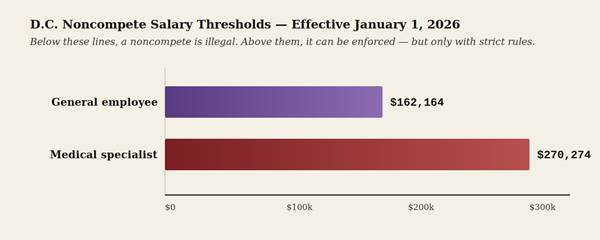
The starting point is a presumption of illegality: D.C. employers may not request or require a “covered employee” to sign a noncompete. A covered employee is essentially anyone who is not a “highly compensated employee” and who either spends more than half of their work time in D.C. or is based in D.C. The thresholds for “highly compensated” are recalculated every January for inflation. For 2026, they are: $162,164 in total annual compensation for most employees, and $270,274 for “medical specialists.”
“Medical specialist” is defined narrowly: a licensed physician who has completed a residency and works for an employer that primarily provides medical services. A staff nurse, a PA, a dentist, or a physician early in residency is not a medical specialist for D.C. purposes, those workers fall under the general $162,164 threshold.
If the noncompete is allowed, it still has to clear five hurdles
Even when your compensation lets your employer use a noncompete, the agreement is unenforceable in D.C. unless it:
Specifies the functional scope — which services, roles, industries, or specific competitors you are barred from;
Specifies a geographic limit;
Lasts no more than 365 days after separation (or 730 days for medical specialists);
Is provided to you at least 14 days before you start, or at least 14 days before you are asked to sign if you already work there; and
Comes with the District’s required statutory notice of rights.
Two specific D.C. wrinkles to know
Broadcast industry employees cannot be subjected to a noncompete in D.C. at all, regardless of pay.
Anti-moonlighting policies — Your employer telling you that you cannot have a second job while employed there — are regulated separately and require written notice to the employee.
04 — Side by Side
Maryland and D.C., compared.
THE COMPARISON · 2026
MARYLAND
DISTRICT OF COLUMBIA
Source of law
Statute (§ 3-716) + common law
Statute (D.C. Law 23-209, as amended by D.C. Law 24-175; D.C. Code § 32-581.01 et seq.)
General wage floor below which noncompetes are void
150% of state minimum wage
$162,164 in 2026(rises annually with CPI)
Healthcare carve-out
Direct patient care + license + ≤ $350,000 = void; above = capped at 1 yr / 10 miles
Below $270,274 (medical specialists): void; above: up to 2 yrs with limits
Veterinarians & vet techs
Total ban, any salary
No specific provision
Broadcast employees
No specific rule
Total ban, any salary
Max duration (high earners, non-medical)
"Reasonable" (case-by-case)
1 year, hard cap
Max duration (medical specialists)
1 year (statutory)
2 years (statutory)
14-day advance review period
Not required
Required by statute
Mandatory written notice of rights
Not required (must notify patients when an affected provider moves to a new practice location)
Required (specific statutory language)
Anti-moonlighting policies
Permitted (common-law reasonableness applies)
Permitted only in limited cases, with notice
Non-solicitation & NDAs
Generally allowed if reasonable
Generally allowed; NDAs expressly carved out
05 — What To Do
If a noncompete just landed on your desk.
01.Don’t sign it yet.
In D.C. the 14-day review window is your legal right. In Maryland there is no statutory window, but ask anyway — refusing a reasonable review period is a tell about how the employer will treat you later.
02.Map yourself onto the thresholds.
Calculate your total annual compensation, including bonuses, commissions, and (in D.C.) vested equity. Confirm the jurisdiction by where you actually work, not where the company is headquartered.
03.Read the clause for traps.
A noncompete that says “the United States” or “any business in the same industry” is almost certainly unenforceable in both jurisdictions — but you still want the language fixed before you sign, not after.
04.Look past the noncompete to the non-solicitation and NDA.
In our experience, these clauses do more damage to mobility than the noncompete itself, and they are far more likely to be enforceable in both Maryland and D.C.
0.4 Get a lawyer to review before you sign — not after.
A review before you sign costs a fraction of what litigating over an unclear clause will cost two years from now. This is true on both sides of the Beltway.
ABOUT LEBAU & NEUWORTH, LLC
Lebau & Neuworth, LLC is an employment law firm representing workers — including physicians, sales professionals, executives, and middle managers — in Maryland and the District of Columbia. We do not represent employers. If you have been asked to sign a noncompete, or you are leaving a job covered by one, we are happy to review your agreement and walk you through your options.
DISCLAIMERThis document is for general informational purposes only and is not legal advice. Reading it does not create an attorney–client relationship. Maryland and District of Columbia noncompete law is complex and fact-specific; the rules summarized here are accurate as of May 2026 but may change, and important details (such as how “total annual compensation” is calculated, whether a particular employee qualifies as a “medical specialist,” and how the District’s “covered employee” geography test applies to hybrid and remote workers) often turn on specifics the law has not fully resolved
Share This Story
If you found the information provided in this article helpful, consider sharing to your social media to help others in their search for reliable information.
Related Posts
Featured / 10.12.2026
Lebau & Neuworth Recognized in Chambers USA Guide 2026 for Employment Law
The information on this website is for general information purposes only. Nothing on this site should be taken as advice for any individual case or situation. This information is not intended to create, and receipt or viewing does not constitute client relationship.
Send Us Your Case Details
Call (410) 296-3030 or fill out the form below. We’ll respond and let you know the best way to proceed with your case.